Technology Governance vs Technology Due Diligence: What Each Does and When You Need It
The short version
- Technology due diligence happens once, before capital moves. It asks whether the asset does what was promised and what risk sits underneath.
- Technology governance happens after, on a regular cycle, for as long as you own the asset. It asks whether what passed inspection still holds.
- They are different engagements with different questions, different people and different outputs.
- The risk a company carries the day after closing is rarely the risk it carries eighteen months later. A one-time report cannot see that.
- A technology governance framework gives the board a steady view: a short set of areas reviewed each quarter and a plain report.
The used car test
Would you buy a used car without a mechanic checking it first? Most people would not.
Now suppose you bought the car and never looked under the bonnet again. Two years later, after the long drives and the servicing you skipped, you would not know what shape it was in until something failed.
Many investors treat technology that way. The deal closes, the diligence report is filed, and nobody looks at the technology again until something breaks.
The analogy has a limit. A car does not change after you buy it. A technology business does. It ships new releases, changes vendors, loses engineers, moves cloud providers and meets new regulation. The inspection tells you the condition on one day.
Two moments, two jobs
| Technology due diligence | Technology governance | |
|---|---|---|
| When | Once, before closing | Every quarter, for the holding period |
| Main question | Does the asset do what was said, and what is the real risk? | Does what passed inspection still hold, and what has changed? |
| Output | A report and findings that inform price and terms | A short board report, trends and actions |
| Reader | Investment committee | Board, operating partner, management |
| Depth | Wide and deep, in a short window | Focused, with trends over time |
| Cost of getting it wrong | Overpaying or inheriting a hidden problem | Missing a problem while it is still small |
Neither replaces the other. The technology due diligence checklist sets out the questions for the first. A strong diligence report with no follow-up leaves a long gap. Governance with no baseline has nothing to compare against.
What changes after the deal closes
This is an illustration, not a client story.
Consider a software company that passed diligence with a few manageable findings. Eighteen months later:
- Two of the five engineers who understood the core platform have left.
- The company has moved part of its infrastructure to a new cloud provider, and a few access rules were copied over without review.
- A new regulation now applies to the data it holds.
- Releases are slower, because the quick fixes made before the deal have piled up.
None of these is dramatic. Each is the kind of change a quarterly review would have caught early and a one-off report cannot. The investor who looked only at the closing report would still believe the original findings described the company.
What a technology governance framework covers
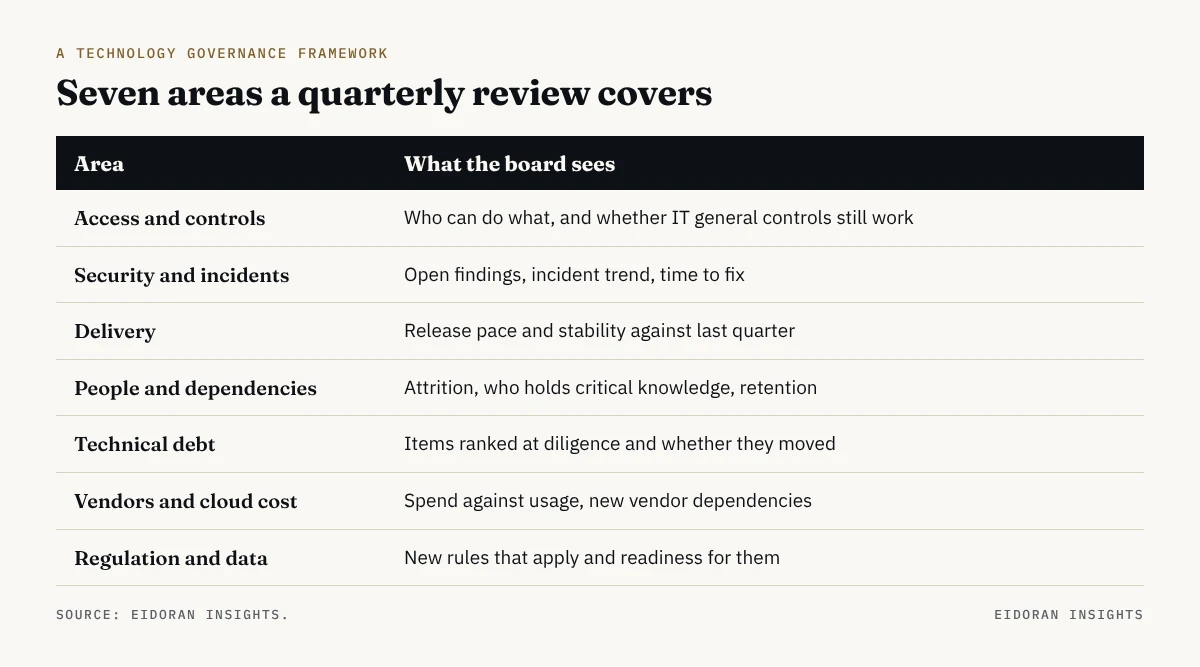
A technology governance framework does not need to be heavy. For most companies it is a short list of areas reviewed on a schedule, with a baseline from diligence:
- Access and controls: who can do what, and whether the basic IT general controls still work.
- Security and incidents: open findings, incident trend, and how fast things are fixed.
- Delivery: release pace and stability compared with last quarter.
- People and key dependencies: attrition, who holds critical knowledge, retention of key people. See key person risk.
- Technical debt: the items ranked at diligence and whether they have moved. See how to price technical debt.
- Vendors and cloud cost: spend against usage, and any new vendor dependency.
- Regulation and data: changes in rules that affect the company, and readiness for them. See the DPDP Act post for an Indian example.
The output is a plain report for the board. It has trends, a few items needing a decision, and the actions agreed at the last review with their status.
What governance is not
It is not an audit opinion, and it does not replace management. Its job is to give the board an independent, regular view so that decisions are made with current information.
It also does not have to be expensive or constant. The aim is steady attention at the right frequency, not constant surveillance.
Where the two overlap
In practice some investors already monitor their companies, and some repeat diligence before an exit. Good governance reuses the diligence baseline. Good diligence leaves a list of things to watch. The two form one loop: inspect, hold, review, then inspect again for the exit buyer.
Which one do you need
- You are about to invest or acquire: you need due diligence. It is the pre-purchase inspection.
- You hold a company and have not looked at its technology since closing: you need governance, starting with a fresh baseline.
- You are preparing to sell or list: you need both. Governance shows the trend and a sell-side readiness review shows what a buyer will find.
- You sit on a board without technology depth: you need governance, so that you can ask better questions in the room.
Eidoran advises investors and boards on this through its technology due diligence and governance practice. Related reading: technology due diligence checklist, key person risk in startups, how investors should price technical debt, the DPDP Act and technology due diligence, Series A technical due diligence.
Frequently asked questions
What is the difference between technology due diligence and technology governance?
Due diligence is a one-time assessment before an investment or acquisition. Governance is a regular, ongoing review after it. One establishes the baseline, the other watches how it changes.
What is a technology governance framework?
It is a defined set of areas, such as access, security, delivery, people, debt, vendors and regulation, reviewed on a regular schedule and reported to the board, with actions tracked until closed.
How often should technology governance reviews happen?
Quarterly suits most companies, with extra reviews when something material changes, such as a major migration, an incident or a leadership change.
Do private equity firms need technology governance after closing?
Most benefit from it. Value creation plans often depend on technology, and a regular independent view helps spot slippage early, before it affects the exit.
Can the same firm do both?
Yes, and there is a practical advantage: the team that made the baseline can measure the change. The reviewer should still be independent of the management being reviewed.
Evaluating a deal, or holding one?
Request a confidential briefing on independent technology assurance.
This material is prepared for the general information of boards, investors and advisors, and does not constitute investment, legal or accounting advice.